Wednesday, February 5, 2020

Trees of Mill Creek Park

VanBooven Tree Care, the company I help manage, has been doing work at two designated Arboretums in Kansas City Missouri.
We recently completed work at Loose Park and Mill Creek Park. I have a few photos of the trees
in Mill Creek Park I would like to share. Mill Creek Park is on the East side of the Country Club Plaza. This is another iconic Kansas City park, with some interesting large, old trees.

This work is part of the fourth contract I have landed for Arboretum/Park pruning in KCMO.


Vanbooven Arborist Luke Becker-Pruning the first tree at Mill Creek Park, a huge , old Ash tree.


Pictured below: VanBooven Arborist Chris Brewer pruning a large, old double trunked Black Oak.
We removed some large hazardous deadwood and also reduced significant portions of the canopy.


Pictured below-Another shot, from a distance, of the same double trunked Black Oak.


Pictured below-Arborist Luke Becker pruning one of the many mature Oak trees in Mill Creek Park.
Luke is not only an ISA Certified and Kansas Certified Arborist, he also has a degree in Horticulture
from Kansas State University.


Below-One of the giants of Mill Creek Park-This Red Oak is over 80 feet tall, with a massive trunk.


Below-Pruning a large, mature Elm-this tree needed quite a bit of work, looked great when we finished it!.


Below-Another shot of the first grouping of trees we started in at Mill Creek Park.


Below-I am always on the lookout for cool or unusual looking trees-this Mulberry growing along the walking trail does not disappoint.The large burls-shape and texture, make for an interesting photo.

Below-The same burled Mulberry being pruned!


Last photo below- I really like this one-A shot of the fountain running, with happy, freshly pruned trees.


Most days I have the greatest job in the world-we are always grateful for the opportunity
to work on Arboretum/Park trees. Shout out to Alice Hannon-KCMO Urban Forester for all of her
help and guidance on these projects.  Thanks to Chris Brewer, Luke Becker and D'Angelo Hicks  for putting in the time and expertise to make this project another VanBooven  Tree Care success story.

Wednesday, January 22, 2020

Public Martial Arts, Private Martial Arts and Martial Arts Infomercials


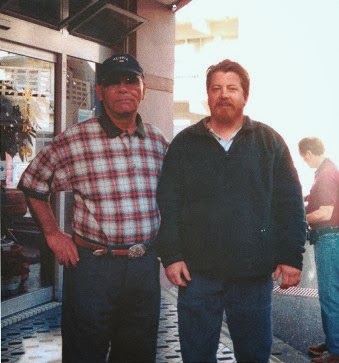
 One of my favorite pictures of all time-Taika Oyata and I at the Yagi Hotel, Okinawa Japan
in 2002. Jim Logue is in the background.

I have always held my teacher and his martial arts in the highest regard!

 Public Martial Arts, Private Martial Arts and Martial Arts Infomercials-
Taika Oyata used to tell us "most people will never understand my karate".
As time went by, I understood what he meant. Most people would never spend the time it takes
to truly understand his martial arts. It is not uncommon for people to take the path of least resistance, to focus on the easy tasks, the low hanging fruit. I personally trained, at the very least, a couple of hundred people at two martial arts schools over several years. There are only a few of these people still training, the ones that are still training  have become quite skilled.
I will take a little credit, but mainly the credit is theirs-they possessed the drive,  the desire to focus
on one martial art-to try and learn/understand Taika Oyata's art-they never gave up!
I  respect  most of the the people from Mr. Oyata's system that are still actively engaged in his martial arts.


It is difficult to teach, especially large groups of people. You have to put a lot of time in, explaining every nuance-it was difficult enough to learn this system, trying to explain it all becomes another thing in itself!

I am currently focusing on our research group and training with/sharing information with a small group of people. We have a dedicated group that has been meeting /training with Hanshi Steve Stark. We have chosen to keep our group private and to not share/ post videos of what we do, what we are working on. I believe at the higher levels, martial arts should be somewhat of a secret-I am not sharing information or techniques with people who have not sweated and bled with me for this art.
I can guarantee you that martial artists from times past did not share their techniques or knowledge with outsiders or people they barely knew. Why would they?
I am inclined, along with our group, to keep my martial arts private. I am a proponent of
private martial arts-small groups of people with shared values working towards a common goal.


To be clear, I refuse to accept money for teaching anyone martial arts-I will either train someone or I won't. I don't expect people to understand or agree-this is my way.
I feel there are some things money should not be able to buy-some things must be earned.

To be quite honest, not every person is worthy of my teacher's martial arts or deserves them.
 Some of the old masters felt you should not "eat" off of karate, I feel the very same way.
I am not judging anyone that makes a living teaching martial arts-it is difficult to do
and I wish you continued success, it's just not my way.


I believe there are many traditional martial artists teaching Mr. Oyata's art in a respectful manner. I wish them success, they have my respect and my blessing.

There are currently any number of people posting video online of Mr. Oyata's kata, drills, techniques.
People are free to do/post whatever they want and I will feel free to comment on these events.

Some of these videos remind me of  a huckster shilling his wares, trying very hard to sell you something or prove to the world how much they know, how great they are-some of it seems a little desperate to me!  Like a bad case of the look-at-me's!!

I guess some people are not content just training and teaching small groups-they need an audience, lots of attention.
My personal feeling is it's hard for anyone to have much respect for people that seem to be trying waaaayyy too hard- selling Mr. Oyata's art.

Don't listen to me, I am just stating how I feel-Do whatever your conscience allows.
I take comfort in the fact that I am not selling Oyata martial arts infomercials-performing techniques on somebody slow punching at me or just holding their arm out for me to perform a technique on.

I wonder if in days past traveling martial artists shilled their martial arts to passerby-
"Step right up ladies and gentleman and I will show you the secrets of tuite, my opponent is going to slow push, slow punch or just hold his arm out, look how I twist him up and take him to the ground, I am
truly great! sign up right here!!😆

It is no great secret that many of Taika Oyata's students do not like each other -this group hates that group , this guy hates that guy-it all became very tiresome years ago. Who cares?

I am however,  a little concerned about what type of people Mr. Oyata's students have become and how they represent themselves.
I believe there are a few individuals misrepresenting themselves as close, personal students of Mr. Oyata.
If you were a close, personal student of Mr. Oyata, you should have been ,at the very  minimum, a Godan level martial artist in his organization.
All of the close, personal students of Taika Oyata, those students he felt were of good character and qualified to pass on his martial
arts, received a scroll in his family art, Oyata Shin Shu Ho Ryu.
Not everybody made the cut-there were some individuals he did not allow to receive a scroll in his family art. I truly believe this omission speaks volumes about their character and
abilities.


I encourage everyone  in Ryukyu Kempo and Ryu Te to teach for the right reasons-to hold Taika Oyata and his martial arts in the highest esteem and  to remember the words of our teacher, his teachings, the Dojo Kun, the Guiding Principles. These things matter greatly.
 Taika Oyata had an ideal, it was Oyata Shin Shu Ho Ryu "To strive to attain true moral goodness and express it through one's every action" . 
Taika Oyata gave scrolls to those he thought would pass on his martial arts, that were of good character and worthy to teach his martial arts.

I am content to continue my training with our research group and finding a few worthy people to train privately. I will leave the  martial arts infomercials to everybody else.

Monday, October 21, 2019


Perseverance -A Pillar of Martial Arts and Life

Martial arts is a marathon, not a sprint-it should be a lifelong endeavor of physical, mental and moral improvement.

Martial arts has always been a journey of self discovery, self-reliance.
We all need good teachers and the support of senior students, fellow students, but
we ultimately must be able to stand on our own two feet and fight for ourselves.
I have always loved the personal empowerment of karate-watching people discover they are strong-they can do this, they can be good at this- powerful, self reliant., fearless-that this power is inside them, of their own making-they own it.
As a teacher, this was and is always a beautiful, powerful  moment to witness-when you see students realize  they are strong-they can do this, that they are good at it, that they continue to improve and they will never give up!
I tell people martial arts is a game of inches, not yards. It can be hard to track your own
improvement, it tends to be incremental. For some people , instant gratification is necessary. The repetition-endless kata, drills and exercises are too boring, too tedious . Many people give up, stop training when it becomes difficult or they become bored or complacent. As a teacher, I can tell you all about the frustration and sadness you feel when promising students drop out , give up or just never come back to a class.

I cannot give someone ambition, strength or endurance/perseverance. It has to come from  you.
A good part of life is just showing up with a respectful, positive attitude- in martial arts you should also be listening
carefully to your teachers,
not just listening, but reading between the lines.
Sometimes your teachers are waiting for you to ask the right questions-if they just give you the answer, if they show you everything, you have not worked for it, have not earned it-it's like cheating on a test.
Nothing good or worthwhile is ever easy.

The good teachers are hard on us-they demand more, they push harder, not satisfied until they see you are giving everything you have-they are waiting for the moments when you rise up-when you meet the potential they see in you.
We owe it to ourselves, our teachers and all the great martial artists whose footprints we follow in kata to never give up, never stop trying-not being complacent or convinced we have mastered something.
The world is full of people who give up when things become difficult.
I am convinced a person's true character is revealed when things are difficult, when life or circumstances have you down.
Will you rise? Or will you just stay down, defeated.

How badly do you want real martial arts training?
What are you willing to endure?
In my younger days I used to worry about who was better than who. I felt like I was competing against everybody at all times. I used to train like a madman before tournaments- then a funny thing happened. I was furiously  training at headquarters and Mr. Oyata was watching me-He asked me what the hell I was doing, what was wrong with me.
I told him I was training for the tournament and he told me to stop and come over to him. He looked me in the eye

and told me you can only train-you can't train for the tournament-you are either ready-right now, or you aren't.
Ladies and gentleman-ponder those words for a minute-that is true wisdom from a master of martial arts.
 I have never forgotten his lessons and I will never forget the martial arts he taught me.

I am no longer competing with anyone but myself. It is a constant struggle to fix bad habits, correct kata motion, make changes in technique that work for me, my body, my timing. I believe I am halfway to my true potential in martial arts.
It is entirely possible I will be a martial arts master at 106 years old!

We all aspire to greatness in our martial arts. Only through  many years of constant practice,
dogged determination-a fierce will to succeed can we hope to rise to any level of greatness.

As human beings, we are equally capable of wondrous, great deeds in our lives. We can inspire others through our example and actions. I believe the expectation of my teacher was that we all become better martial artists and better human beings over time-you can't get there overnight.

I firmly believe that inside of every human being is a tiny spark of the original fire, a small piece of the divine-what  will you do with that inner fire, with that spark-what will you feed it with? 
My teacher, Taika Seiyu Oyata left the world an incredible gift-His wisdom and his martial arts.
What will we do with it?

Tuesday, November 13, 2018

Back to Basics


Back to Basics-
"Move from easy to difficult and from simple to complicated. More time is required to train longer and harder as you progress. Do not hurry or engage in senseless or reckless practice. Develop gradually"


Does anyone still read and follow the Guiding Principles? I know a few groups out there still do.
Years ago,  I tested for my Green belt and  had 3 Brown belt tests in front of Mr. Oyata.
(We had 3 degrees of Brown Belt)
I considered it a great honor to do so. I took it as a challenge, a means to rise.
You had to step up your game to a new level.
He would ask us to recite the Dojo Kun and would ask us
not only to recite the Guiding Principles, but would then make us explain individually,in great detail, what they meant to you . He was more concerned about your intelligence, ethics(or lack of) and understanding of his code than he was about your kata.
Of course he expected your kata to be worthy, it had to be-but in those moments it always seemed to me he was more concerned about what type of person you were, who was he training, he seemed greatly interested in each one of us as individuals and why we wanted to train in his system.

Our martial arts research group, Goshin Jitsu, has moved indoors with the approach of Winter.
With the change in seasons comes a  slight change in our  training regimen. We will be working more on basic and intermediate kata and concepts this Winter. Because we are a research group, we often work on advanced kata, weapons and technique. While we are working on advanced  concepts, we also keep this ideal-The core/root teachings of Ryukyu Kempo lie in basic/intermediate kata and exercises. I will argue this point with anyone until the end of time.
You must have strong basic and intermediate kata  first, before you can  have smooth, powerful advanced kata, technique and understanding of both.

Some karate  practitioners  want to learn and work on advanced kata all the time.
This can be problematic-If your basic and intermediate kata had no power, timing or precision,your advanced kata will reflect this and for practical purposes will be next to useless.
I have personally witnessed some supposedly high level martial artists with very poor  kata- they look like they are just going through the motions-no particular power, no spirit.
According to my teacher, Taika Seiyu Oyata, your technique and mastery of karate will always be a direct reflection of your  kata. If your kata is poor, weak or looks like you are just going through the motions, what does this say about your technique and mastery of karate? Remember, this is coming directly from my teacher, not just me.

Taika Oyata stated to us several times he could look at your kata and know if you could fight, had any technique. After 33 years of training, I am coming to understand what he meant.
One of the best (few) compliments I ever got from Mr. Oyata was after he watched me do a particular kata,he walked by and said-" kata ok,  like you  fighting, this pretty good ".
I strutted around for a few days until he told us in the next class we were all lazy-he gave us too much candy(was too easy on us, taught us too much), we couldn't do kata correctly, didn't listen, our kata was weak ...............some days you are the hammer, other days the nail.

At one point during Headquarters training, Mr. Oyata told our class that eventually we would not need to practice basic kata anymore. He should have explained in greater detail so everyone really understood what he meant. He did not mean at that moment, or 2 weeks later, he was speaking of years into the future! There were people that misinterpreted this and decided he had told them they were so good they never had to practice basic kata again. That is not what he said!
Mr. Oyata would tell us at times we were trying too hard to mimic him, trying to be him.
He felt we were trying to operate at a level that was beyond our physical grasp. He was giving us a lot of ideas, timing and techniques, but we had just learned them-we had not practiced them enough and really didn't completely understand what he had shown us. He wanted us to understand and accept we had to develop gradually- you don't just see something one time and instinctively/intuitively understand it!

As Mr. Oyata's personal students, we were expected to know basic, intermediate and advanced kata
and be able to do them as close to perfection as possible,  at a moment's notice. To be quite honest, there were only a handful of people I felt had exceptional kata and technique. This is not meant to take anything away from anybody, but you could always tell who trained all the time and pushed themselves, who took this seriously and who thought it was a social club/fraternity. I ask the people I am training with if they want to be good, or do they want to be great? You can be good with 75% effort, to be great requires a lifetime of study at 100% effort.

We now  have a world full of internet tough guys, instant experts, would be masters and seemingly very few of us actual students left.There are also a lot of people who went to 3 seminars with Oyata or trained for a few years that have managed to retain their extraordinary abilities even though they haven't actually trained hard for years-That's amazing! I wish I could remain forever awesome but not have to train anymore - What a concept -I'm just great because I used to train!!! I have no use  for people that sit around doing nothing, just talking about martial arts or even worse- talking smack about other martial artists but don't take the time to actually work on martial arts. You were a martial artist, it's impossible for me to take anyone seriously claiming to be a martial artist that does not practice!


I have trained alongside great martial artists and trained for many years with a real master.
I have only met and known one true master in my lifetime-have not seen another human being like him anywhere and don't believe I ever will. There is nobody  I have met that can fill his shoes, nobody with his skill and depth of knowledge. I consider myself to be truly fortunate, I am trying to pass on what I learned to a small, dedicated group of personal students/peers. At this time I am fairly satisfied with my efforts, but there is always much more work to be done.

For the record, I still work on basic, intermediate and advanced kata, ready to do them at a moment's notice, just as my teacher expected. I am content to continue developing gradually, always a student.


Tuesday, August 28, 2018


 I am devoting my spare time and energy to creating a video and informational archive for our martial arts research group.I will be posting videos of Ryukyu Kempo Karate and Kobudo exclusively on the Goshin Jitsu Research Group Facebook page. I will also be posting some of my personal notes regarding tuite, kyusho, kata breakdown, foot work, diagrams, exercises, body mechanics- notes and drawings I made during my 17 years of training with Taika Oyata. This will not be available to the public, they can only be viewed on the Goshin Jitsu page. Only people currently training with the Goshin Jitsu Research Group or past members in good standing are permitted access to our Facebook site.


Tuesday, May 1, 2018

The Importance of Understanding Kata


*This blog post is dedicated to Mikasan-  a martial artist of integrity, a man  I have never met, yet consider a  good friend!

**"I cannot teach anybody anything, I can only make them think"-Socrates

The importance of understanding kata-Naihanchi:

The ancients left a blueprint, a roadmap for us to follow if we are wise and willing to put the time in to truly understand what we are practicing.This is a lifelong process of  anguish, tediousness, frustration, discovery and finally understanding.

One of the most important things we all learned from our teacher Mr. Oyata was how to interpret/read
kata.I would have figured out very little if any of this on my own. He felt it was vitally important to do the basic kata until it was ingrained, part of you.
This was your foundation-once this was achieved you could build upon it, move on to the next. evolution/timing. He taught basic kata for many years-in fact, there were many individuals that were only exposed to basic kata, fundamentals and very basic techniques. Many left before he changed timings and began to teach intermediate and advanced kata and techniques. In their own minds, these individuals became convinced they had learned his"Art", everything he had to teach-in reality they had just scratched the  very surface of our teachers martial arts knowledge.

When I started training with Mr. Oyata and the Kansas City black belts in 1990, we were
doing basic Naihanchi Shodan and intermediate Naihanchi Shodan. I had been doing basic since 1986
and he had just introduced intermediate timing to everybody the year before.I had to do basic and intermediate timing as part of my black belt test in 1990.
People were struggling to put moves together to his exacting standards.
We worked exclusively on this kata and timing every night, for weeks/months on end.We were also doing this timing as a group for demonstrations at tournaments. Our teacher felt if you could not do the kata well with this timing, you could not duplicate his techniques/applications-i.e. you were wasting your/his time.

My teacher's kata, weapons and fighting system are highly sophisticated-it was never easy to learn!
Even something that would seem as basic as footwork is highly advanced in comparison to other styles. Footwork is the cornerstone of my teacher' martial art, the hand technique is useless without it.
Neglect it and you have nothing of  real value.

It was around this time I heard my teacher say some interesting things about  Naihanchi Shodan kata motion:

"foot cross in naihanchi have different meaning-sometime I sweep, sometime I hook foot or leg, sometime I move back or forward-but sometime crossing foot just mean foot is moving-that's all-I step, maybe step forward, or step back or out to side.

"hand motion start, hand follow hand, foot follow hand. No can start foot first-this no make sense for defense".

"Aim from middle of body-arms go out from middle, come back to middle, "

The first time I ever saw Mr. Oyata do technique for a grab from behind, it was when we were working on Naihanchi Nidan, basic and intermediate timing. He began to show some different techniques and explained that although the kata were practiced on a straight line, I could still be doing the techniques after twisting/turning and starting a new line facing my opponent who had grabbed me from behind. A giant lightbulb went off in my head upon hearing this-It had never occurred to me that the line could change-I could be fighting any direction, doing these techniques when turning-creating a new line every time I turned,as defending myself dictated.
His previous statement about the crossing foot in Naihanchi made perfect sense-I could be stepping back behind my other foot to turn quickly to counter my opponent grabbing from behind.

Wrap your head around the idea that the kata /technique are abstract-I have to think outside of the box-more of a "what could it be"? than "this is what it looks like" Consider the possibilities when practicing individual kata. What are the unique moves? what are the repetitive moves? Why would I move this direction while doing this?

The lines we practice on, the directions seem to be  a suggestion, a book of good advice.
Remember, those lines  we are fighting on are always changing as the attack or response dictates.
Basic can be a straight line,  advanced may be multi-directional/ eight directions.

The ancients cleverly hid their ideas in the kata, like a riddle. It takes many years of constant practice to truly understand this body motion., the meaning of these movements.
 Naihanchi Nidan is rather complicated-it is a kata of  strange, short movements, precarious balance and backwards technique/fighting. I have seen some horrible versions over the years-my previous kata included. I have worked on this one for years-it's coming along nicely!
Very few people can do this kata well, with power, precision and timing and an understanding of what it means-those that can tend to have exceptional technique.

The most important thing I could share with everybody is the importance Mr. Oyata placed on breaking down kata and working on small pieces/segments. It was maddening-frustrating to only work on 2-3 or 3-4 moves over and over again, but is is exactly how and why our kata got better over time. I still do it when a  particular segment feels weak or funny to me.

I was extremely fortunate to have the experiences I had and the training that I received from a true Master. I am going to continue these posts based on the responses I have received. There is quite a bit of this I am covering in the book I am working on. The book is progressing slowly, the way it needs to. I intend for it to be very good, we shall see.

Thursday, April 26, 2018

Trees of Loose Park 2018 by Brad Hatfield

VanBooven Tree Care, the company I help manage, has received it's third contract for
pruning at the Loose Park Arboretum. We all feel fortunate to have the opportunity to
take care of these trees, it's quite an honor for our company to be chosen again.
 This is a team effort, from writing the proposals to having
the people and equipment to get the job done well. VanBooven foreman Chris Brewer and
his lead Arborist Luke Becker have been out there every day, providing the pruning expertise we need.
These two are the reason I have every confidence when out bidding tree work or writing proposals to care for rare and valuable trees, knowing they have the combination of intelligence, skill and experience in everything they do. We also needed machines and muscle to manage the tons of deadwood taken out of these trees- D'Angelo Hicks was the man with the machine and the muscle to get it done.
 I have been on this job nearly every day as a project manager, but more importantly to me, I have also been able to prune quite a few trees while there.

I wanted to share some of the pictures I have taken while out working on this project:


Pictured below is a huge, roughly 150 year old Walnut, located on the west side of the park.


Pictured below is a shot taken inside one of the Pine and Spruce groves.


Pictured below: Vanbooven Arborist Luke Becker pruning a giant Cucumber Magnolia. This is the largest, oldest Cucumber Magnolia tree I have ever seen.
Also want to mention that Luke Becker has done a fantastic job pruning these trees. Luke is not only a Kansas Certified and ISA Certified Arborist, he also has a degree in Horticulture from Kansas State University. It has been a genuine pleasure working with him and watching him mature into the consummate professional and expert pruner he has become.


Pictured below is a gnarly old Elm, covered in burls.  I love the shape and texture of the burls-  fantastic. This is a really cool looking old tree, picture taken prior to pruning.


Pictured below: The largest Pine and Spruce grove  located on the West side of Loose Park


Pictured below is another huge, very old Walnut tree being pruned. This tree is so massive it makes our bucket truck look like a  car! I could not fit the entire canopy in the picture.


Pictured below: Inside one of the Eastern Redcedar groves. Redcedar are a fantastic evergreen for Northeast Kansas, these are tough trees-resistant to disease, drought- I call them Kansas Redwoods.


Pictured below:Just in case there are Redcedar fans out there, I am adding an additional photo of
some large old trees.


Pictured below: VanBooven Arborist John Cox pruning large, old Norway Spruce tree


Pictured below: Massive old Siberian Elm. We spent the best part of a day pruning this tree.
there was huge deadwood, large broken, hanging limbs. This is the finished product.


Pictured below: I saved one of the best for last, a specimen Paperbark Maple tree. This is a large, old
tree for a Paperbark Maple, they grow very slow. Love the muscular branches, shiny, exfoliating bark.
This is another one of my favorites. There are actually two of equal size right next to each other. I practically ran over to where they are to make sure I was the one pruning them.Honestly, I would have pruned these incredibly cool trees for free.

Here is a shot of the same tree at a little more distance.


I took quite a few pictures, these are some of the best ones that I wanted to share.
We only have a few days of work left in the pruning contract.
One of the stipulations of our contract is that the trees be left in as natural a condition as possible-Brilliant!! I could not agree more. We have tried to do that with every single tree we pruned.
Loose Park is a fantastic place to work, I will have to visit when I have more time on my hands to take in the sights.If you get a chance, stop in and  take a walk through the park and enjoy the sights yourself, especially the trees.